
MALAGA 2026


Here I am, off to Málaga, a discovery trip to the heart of Andalusia where popular traditions, modernity, and cultural vibrancy come together.
A Mediterranean city with a strong character, Málaga cultivates a distinctive balance between its port open to the world, its internationally renowned museums, and its quieter neighbourhoods where the Andalusian spirit expresses itself without filters.
Deeply rooted in its traditions, more palpable here than elsewhere, the city asserts an identity that lives through its processions, its local bars, its way of speaking, gathering, and inhabiting the streets.
Arriving in the afternoon, I take the time to settle in calmly.
Since my accommodation is located not far from the port, it is naturally Muelle Uno that I discover first.
MUELLE UNO
Once an industrial area, this space has been transformed into a promenade along the port.
Inaugurated in 2011, Muelle Uno has become a commercial and leisure area in the heart of Málaga’s port, offering a pleasant walk facing the Mediterranean Sea.
It features a good selection of shops, restaurants, and cafés, as well as a small market selling local products.
Along this esplanade stands the Centre Pompidou, recognizable by its colourful cube, which hosts temporary exhibitions.
At the end of the promenade, La Farola, the city’s emblematic lighthouse, recalls Málaga’s maritime history and remains one of its most recognizable symbols.
A very enjoyable place to walk through.

MALAGA PARK
Opened in 1897 and later expanded and modernised around 1920, this 30‑hectare urban green space contains more than 300 plant species from five continents, along with fountains and sculptures.
This oasis of greenery links the historic centre on one side and the port on the other.
It is a pleasant place, much appreciated by both locals and tourists, with benches and shaded areas, particularly welcome in periods of intense heat.

MALAGA MUSEUM
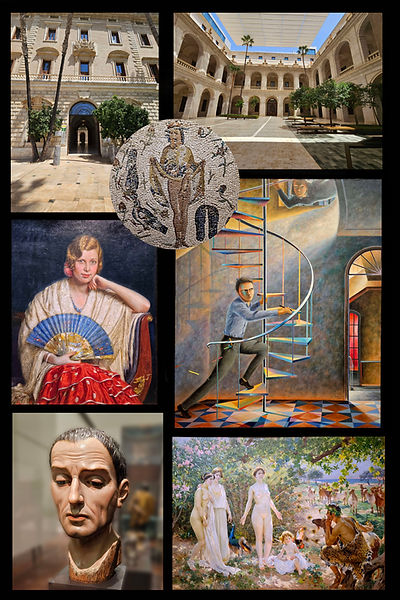
The Málaga Museum is the largest state‑run museum in Andalusia.
The visit begins on the ground floor with the museum’s storage collections: ancient sculptures, archaeological pieces, and religious artefacts.
It continues on the first floor with Spanish paintings from the 15th to the 20th century, along with modern and contemporary works.
The second floor is dedicated to archaeology and presents numerous objects tracing the history of Málaga and its province, from prehistory to the Islamic period, including Phoenician, Moorish, and Roman pieces.
Be sure to admire the beautiful inner courtyard as well.
The museum is free for European citizens upon presentation of an identity card.
PICASSO MUSEUM
The Picasso Museum of Málaga is housed in the Buenavista Palace, a 16th‑century building listed as a historic monument.
It brings together a permanent collection that traces the different periods of Pablo Picasso’s artistic creation; Picasso was born in Málaga in 1881.
The museum displays paintings, sculptures, ceramics, and drawings that allow visitors to follow the evolution of his work.
It also hosts temporary exhibitions that complement the visit.
A superb venue, both elegant and bright, showcasing
the richness and diversity of Picasso’s work.


You can also visit his birthplace (shown opposite), which has now become a foundation hosting temporary exhibitions.
It is located on Plaza de la Merced.
REVELLO DEL TORO MUSEUM
The museum is housed in the former home and workshop of Pedro de Mena, a 17th‑century sculptor.
It presents around a hundred works by the Málaga‑born portraitist and figurative painter.
On the ground floor, visitors can see portraits of his family and still lifes depicting everyday objects.
The first floor is dedicated to female figures.
The museum is currently hosting the temporary exhibition “Festivities in the Posters of Revello de Toro”, featuring works he created for the city, including those for the Feria, the carnival, and bullfighting events.
It is a museum dedicated to the representation of women.

PEDREGALEJO
Pedregalejo, a former fishing village, is located east of Málaga, about 3 km from the Centre Pompidou.
You can reach it by bike, public transport, or on foot. I personally chose to walk in order to fully enjoy the surroundings.
After passing the historic seaside area of Baños del Carmen, the scenery changes and gives way to small, picturesque houses lined up along the seafront, known as Paseo El Pedregal.
There are small restaurants where you can enjoy grilled sardines, among other dishes, as well as the maritime museum and the historic shipyard Astilleros Nereo, renowned for its traditionally built wooden boats.
Still preserved from mass tourism, it offers a more authentic walk.


Baños del Carmen
THE MALAGA FERIA
It began on August 14th with a drone show, followed by a beautiful fireworks display.
The next day, you can watch the gathering of riders and decorated horse‑drawn carriages, evoking the entry of the Catholic Monarchs into Málaga in 1487.
The procession, accompanied by traditional music and dance groups, sets off from Paseo del Parque to make a floral offering to the Virgin Victoria, the patron saint of Málaga.
During the day, concerts and performances take place mainly on Plaza de la Merced, Plaza de la Constitución, Calle Larios, and Plaza de las Flores.
The night‑time Feria is held at the Real del Cortijo de Torres, on the outskirts of the city centre.
Public transport is provided for the occasion.
The Feria runs until August 22nd.

MUSEUM OF ARTS AND POPULAR TRADITIONS
The museum is housed in the former Mesón de la Victoria, a 17th‑century inn.
It offers a journey through the history of Málaga and its province, as well as the customs and traditional activities of the 19th century.
Visitors can discover rural life, with displays illustrating the trades of blacksmithing, baking, fishing, and printing, while also exploring the production of wine and olive oil.
The kitchen and wine room have been recreated with period furniture and utensils.
Upstairs, the lifestyle of the bourgeoisie is presented through costumes and reconstructed spaces such as the Study, the Salon, and the Bedroom, illustrating the daily life of the city’s inhabitants.
Rooms dedicated to Folklore, Ceramics, and Popular Religiosity complete the visit.
A charming and very interesting museum.

STREET ART
When people talk about street art in Málaga, they often mention the Soho district, which has gained an almost legendary reputation and is undoubtedly more tourist‑oriented than the neighbourhood of Lagunillas.
But one afternoon, while walking through Plaza de la Merced, I decided to head into the district just behind it, a place that surprises from the very first steps.
Here, nothing is polished: the walls are covered with committed murals, façades sometimes crumble, and certain plots seem to have been deliberately left unfinished, as if suspended in an incomplete project.
Some artworks are damaged while others remain surprisingly well preserved, and this contrast reveals the true nature of Lagunillas, a living neighbourhood where art evolves with the walls.
During my visit, I crossed paths with only a few residents.
An unusual atmosphere, almost suspended in time.

CARMEN THYSSEN MUSEUM
The Carmen Thyssen Museum of Málaga is housed in a historic building: the Palacio de Villalón, a 16th‑century palatial residence located in the heart of the city.
Its basement contains a Roman archaeological site that includes, among other remains, a Roman house, a fish‑salting factory, and a monumental nymphaeum decorated with figurative paintings.
The museum’s main purpose is to promote 19th‑ and 20th‑century Spanish painting.
Below is the museum’s visitor map.


AUTOMOBILE AND FASHION MUSEUM
The building that houses the Automobile and Fashion Museum belongs to the city’s former tobacco factory.
The Magalhaes family, of Portuguese origin, is behind the creation of this museum.
The acquisition of exotic, extravagant, and mythical vehicles began with the grandfather of the current owner, who transformed the museum into a unique place blending automobiles, fashion, and Art Deco.
Although I hadn’t planned to visit it at first, I’m glad I did: the particularly refined Art Deco scenography was, for me, the true highlight of the visit.

GIBRALFARO – ALCAZABA AND ROMAN THEATRE
The Alcazaba and the Gibralfaro Castle form a defensive complex overlooking Málaga from the hill of the same name.
The Alcazaba, an 11th‑century palatial fortress, stretches below with its patios and ramparts, while Gibralfaro Castle, built in the 14th century, served as a military stronghold.
The two sites are connected by a rampart path, and a combined ticket allows visitors to explore them together.
The views from the castle are superb.
The tourist bus goes all the way to the top, which is preferable for visitors with reduced mobility: the climb is steep, and the descent can be strenuous, especially in hot weather.
The visit to the Roman Theatre is free of charge.

LA CONCEPCIÓN BOTANICAL GARDEN
Created in the 19th century and recognised as a historic garden in 1943, La Concepción brings together more than 3,000 subtropical species along a path where shaded walkways, ancient palm trees, and period architectural elements blend harmoniously.
Located outside Málaga’s city centre, the garden is easily accessible thanks to the tourist bus’s green route, which drops visitors off at the entrance.
Among its emblematic areas, the belvedere offers an open view over the garden, while the lake creates a peaceful scene where local wildlife occasionally appears.
The main path leads visitors to the best‑known spots, but La Concepción reveals much more to those who wander slightly off the route: older corners, discreet fountains, and small unexpected details that can only be discovered by taking the time to look.
With a bit of luck or patience, you might spot a great white egret near the lake, quietly standing in the shallows. »

MÁLAGA CULTURAL CENTRE
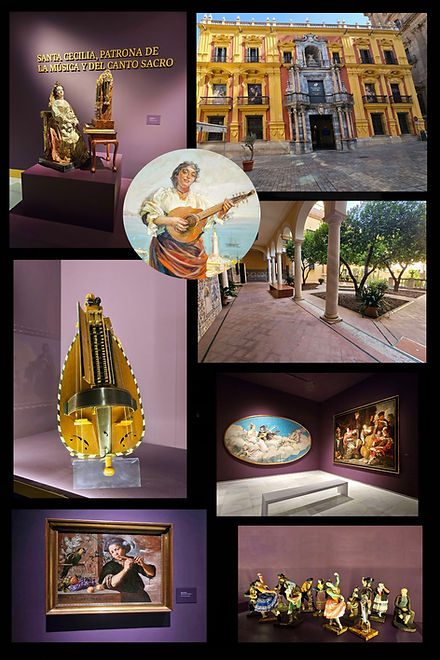
The Fundación Unicaja Cultural Centre is housed in the episcopal palace located on Obispo Square.
The part of the palace open to the public was built in 1762 by the master architect Antonio Ramos.
The palace is an art space where visitors can explore its noble areas: a porticoed courtyard, imperial staircases, a chapel, and a private garden.
During my visit, the palace was hosting the exhibition “Y sonó la música. Iconografía musical en el arte”, a beautiful showcase of the presence of music in art through the centuries, perfectly highlighted within this historic setting.
THE MIMMA
The Interactive Music Museum of Málaga invites visitors to engage in a dialogue with the exhibition.
It houses a vast collection of instruments from all over the world and from every era, presented in a lively and accessible way.
Some rooms, called “Please Play”, encourage visitors to experiment freely: you can try different instruments there, with varying degrees of success, but always with plenty of enjoyment.
This playful approach makes the museum a place where you learn by touching, listening, and trying, rather than by remaining a simple spectator.
The museum also offers a flamenco performance, recognised as Intangible Cultural Heritage of Humanity. I highly recommend it: it is a unique, intense experience, deeply rooted in Andalusian identity.

LA MANQUITA
Nicknamed La Manquita, “the little one‑armed lady”, Málaga’s cathedral owes its name to its unfinished silhouette: only one of its two towers was ever completed.
Built between the 16th and 18th centuries, the cathedral blends Renaissance style with Baroque elements, giving the building a harmonious yet distinctive character.
This imperfection, far from diminishing its charm, has become part of its identity. The people of Málaga are deeply attached to it, and many say they would not want the second tower to be finished, La Manquita simply wouldn’t be the same.

LA MALAGUETA


Unlike several Spanish cities that have abandoned bullfighting, Málaga has chosen to maintain this tradition, which remains present in the city’s cultural life.
To ignore this fact would be to deny a reality that is still part of the Andalusian landscape, whether one appreciates it or not.
With summer temperatures often reaching 33–35°C, Málaga can be challenging for those sensitive to heat.
April and May are much more suitable months to explore the city.
The choice is yours.
My trip is coming to an end, and I will be heading home tomorrow.
I appreciated the kindness and friendliness of the people of Málaga.
They are proud of their cultural and historical heritage, and they defend it with good reason.
Málaga will remain, for me, a city of many facets, rich in contrasts and in moments captured along its streets.